
Palindromes | The science sport | EUROtoday
You cannot wrap an egg in aluminum foil with out creating wrinkles, as we noticed final week; however, as Rafael Granero factors out: “Mathematically (and physically), it is not possible to adapt a flat surface (inelastic or with limited elasticity) to a spherical one without deforming it: either it stretches, or wrinkles, or breaks. Nor the opposite, and that is why we cannot flatten the entire skin of half an orange without it cracking. But if we play with the heat… There are adjustable thermo wrappers, such as heat-shrinkable covers: a plastic sheet that, when heat is applied, shrinks. “It contracts and adapts perfectly to the shape of the object.”
As for the animals whose name contains the five vowels only once, Fernando Garro has cleverly “cooked” the riddle, revealing, once again, the importance of precision in the statements: “My brother-in-law is an animal and his name is Aurelio.”
I had to specify that I was referring to the common name of a non-human animal, and in that case there are some debatable and/or humorous answers, such as “possum” (not accepted by the RAE but colloquially). Or “pachyderm”, which is not the name of an animal but of a taxonomic order (now out of use, by the way); but it is common to call an elephant a pachyderm (although currently the correct thing is to call it a proboscidean), so Javier Andueza’s answer can be accepted as correct. And if we accept the affectionate diminutives, “little hound” (well, the corrector does not underline it in red) and “ant” (this one does) could be valid.
In the same humorous vein, Bretos Bursó proposes “futbolinera” (woman who is fond of table football) as a word that contains the five vowels in reverse alphabetical order. And without moving away from football, a match between Portugal and Chile could also serve: it would be a Portuguese-Chilean competition.
As for the largest number whose name contains the five vowels without repeating them, Bursó proposes “ninety-one thousand”; but Granero switches to Catalan and attacks with “quatre trillions”, and Bursó counterattacks with “cent quadrillons”. Who gives more?
Jaime Zubieta’s answer to last week’s third riddle is “This sentence does not have thirty-five letters.” Is there any other solution?
And the “official” answer to the fourth riddle is “five”; but are there any more?
Verbal symmetry
When talking about games and puzzles with words, it is inevitable to mention palindromes.
A palindrome is a word or phrase whose letters are arranged in such a way that they do not change when read from right to left. There are many palindromic words, especially among the shorter ones: asa, ama, ara, ata, efe, eme, ene, oro, oso, ojos… How many can you find with three letters? And, going to the other extreme, what is the longest palindromic word?
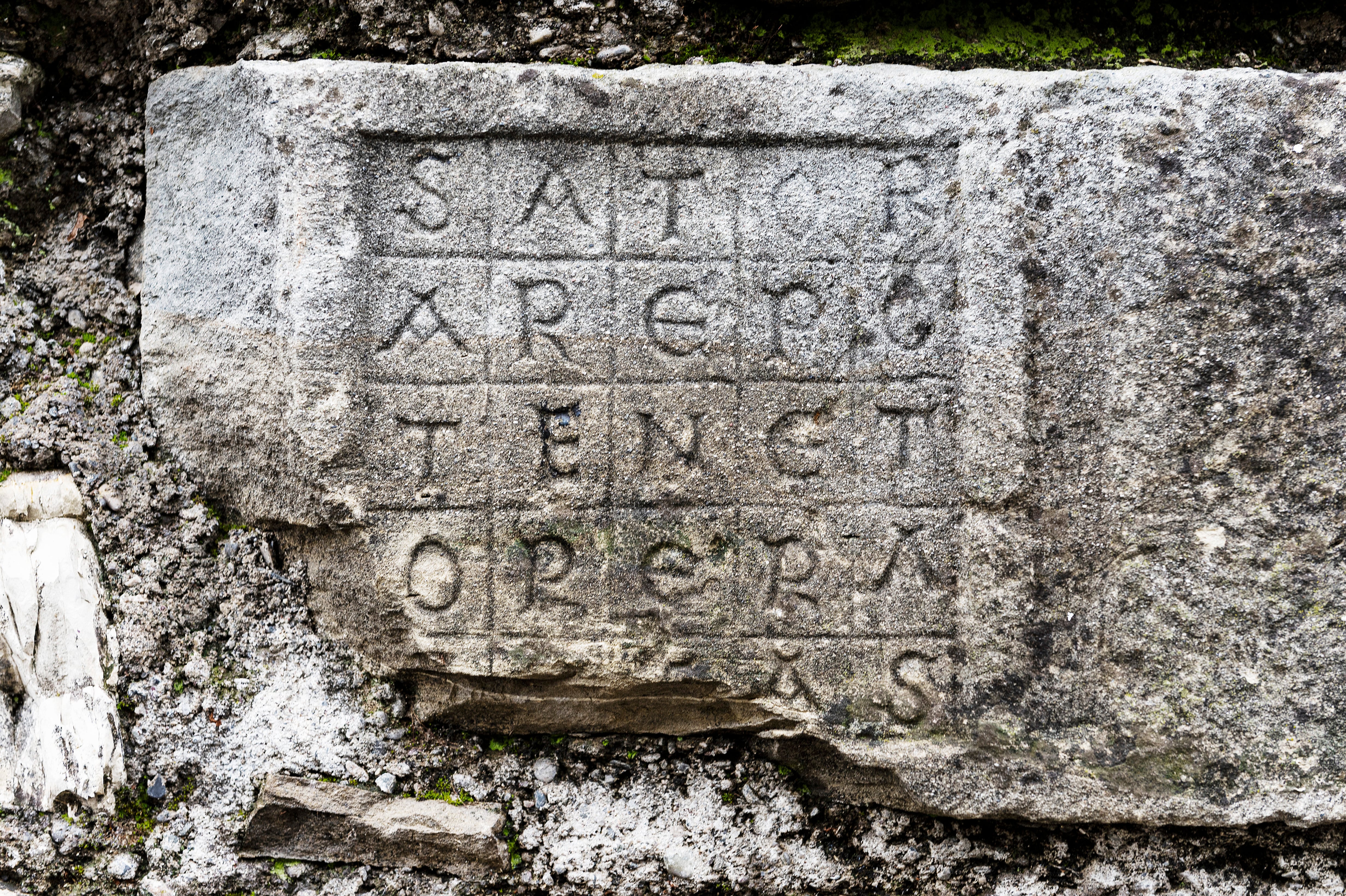
As for the palindromic phrases, let’s remember a couple that are very successful, one popular (in Spanish) and the other cultured (in Latin): “Give rice to the fox the abbot” and “In girum imus nocte et consumimur igni” (We go around in the night and the fire consumes us). The Latin palindrome could be an ancient riddle concerning moths or torches; or to demons, according to some, which is why it is known as the devil’s verse. Guy Debord, founder of the Situationist International, adopted the palindrome In girum… as his motto and made a short film with this title in 1978. And, continuing with Latin, the mysterious multipalindrome of the Sator Square is a must-mention: SATOR AREPO TENET OPERA ROTAS (but that is another article).
In Spanish, the palindrome of the fox and the abbot is difficult to overcome. Can you think of any?
(Coincidentally, or possibly not, that is installment #545 of The Science Game: a palindromic quantity, additionally known as capicua).
https://elpais.com/ciencia/el-juego-de-la-ciencia/2025-11-14/palindromos.html