
The thriller of the second most essential Celtiberian bronze identified and that hides a specific | Culture | EUROtoday
In January 2024, linguist Joaquín Gorrochategui, from the University of the Basque Country, and professor María Cruz González had been alerted to the existence of 5 pictures of a very unknown pre-Roman bronze. “When we saw the images, we quickly understood that it was a Celtiberian piece, apparently in good condition and with epigraphic and linguistic characteristics of great interest. Through a colleague, we conveyed to the owner our desire to perform an autopsy of the epigraph and eventual study, to which he agreed without any problem,” Gorrochategui says within the examine. Celtiberian bronze in Latin alphabet from Igedankom, Complutum, Alcalá de Henares (Madrid). Advance, printed within the journal Sail
In April of that yr, they met the proprietor of the thing at a resort. They analyzed it, measured it and photographed it “during the morning of that day alone, without any interference.” Once the work was completed, they returned it, however they requested the proprietor to permit them to hold out “a cleaning by laboratories specialized in restoration and conservation, a metallographic analysis of the bronze and any sectoral studies that were needed by different specialists.” The proprietor said that he was excited about a “possible donation to a public institution.” But they’ve by no means seen him once more.
On August 12, 2024, “surprisingly, an image of the bronze was leaked on the internet, but the photograph [de no muy buena calidad] It was immediately removed.” However, the archaeologists and epigraphers Martín Almagro-Gorbea and more adjusted to reality, with the epigraphic data obtained from ocular inspection,” Gorrochategui asserts.
What is already known as the Meditón Bronze – the name of the main character mentioned in the object – includes “a pact of hospitality between this particular person and the Carpetan metropolis of Igedankom”, in Roman times Complutum and currently Alcalá de Henares. The city grants citizen rights to the termestino (of Tiermes, Soria) Meditón or Meditos by decision of some magistrates or staff members mentioned at the end of the section.
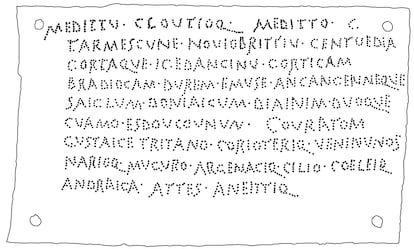
In short, it is a Celtiberian text of great importance due to its length (nine lines with 32 words, plus an abbreviation), its relative good preservation, the use of the Latin alphabet that ensures the phonetics of a considerable number of words, the advanced phase of the language and the presence of some hitherto unknown grammatical forms and categories. It was written during the time of Augustus between the years 27 BC. C. and 14 d. c.
The text is written in the Celtiberian language and in the Latin alphabet, with a stippling technique. The words are separated by periods. All the Latin letters that had exact or approximate correspondence with the Celtiberian phonological system appear. Therefore, the letters F, H, K, P, X, Y and Z are missing.
There is no evidence that this bronze, which now belongs to a private collection, came from a professional archaeological excavation carried out more or less recently. That is, it was looted years ago. According to the owner’s story, it was acquired from an antique dealer in the province of Madrid in the early eighties of the last century by a member of his family, having remained in the family collection ever since. Stating that it was acquired before 1985, when the Heritage Law was approved, prevents it from being requisitioned by the authorities. “I do believe the owner,” says Gorrochategui in conversation with EL PAÍS. “What he says may be true.”
Gorrochategui has translated the text – he calls it interpreted – but making it clear that “it isn’t superfluous to do not forget that, even though analysis in recent times has clarified many elements of Celtiberian grammar and lexicon, we’re removed from absolutely understanding the vast majority of the inscriptions. Although there’s a broad consensus within the understanding of the shorter and repetitive texts, amongst which we embrace the hospitality teserae, the longer texts current “There are still many dark points, despite the existence of suggestive and interesting interpretative proposals.”
This heading, “being complete, written in the Latin alphabet, including terms and words previously known in certain types of documents and having a perfectly identifiable sequence of designations of people in the first and last three lines of the heading,” is comparatively easy to translate.
The linguist concludes: “We are faced with one of the most important Celtiberian texts known, due to its length, its textual integrity and the nature of its content, only behind the great Botorrita Bronzes. [11 líneas]. The fact that it is written in the Latin alphabet is advantageous to know the phonetics of the words with greater precision and accuracy.”
“The owner told me that his intention was to hand it over,” Gorrochategui asserts. “I hope it is like that, because it is unique.”
https://elpais.com/cultura/2026-03-28/el-misterio-del-segundo-bronce-celtibero-mas-importante-conocido-y-que-oculta-un-particular.html